
Discover and Explore the Future of Automotive
NEXT MEDIA
partner by







News
Volver atrás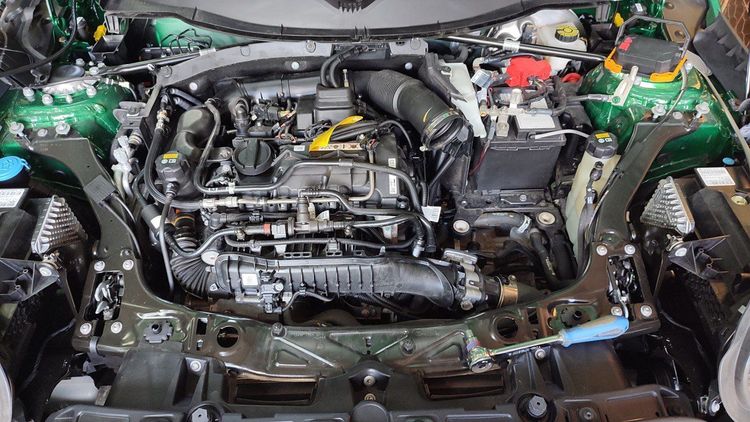
MINI Countryman PHEV: key technical aspects for the workshop. Technical opinion by Ismael Fuentes
The MINI Countryman PHEV is a good example of how electrification has changed the way we understand mechanics. With its combined 220 hp, this plug-in hybrid shares technology with the BMW X1 PHEV, making it a benchmark within the BMW-MINI group's compact range.
Mastering its operation not only allows you to work on this model, but also to understand the common architecture of the entire hybrid family of the group.
Engine and hybrid system
The Countryman PHEV is equipped with a 1.5 Turbo three-cylinder combustion engine (B38) paired with a rear electric motor, reaching a combined power of 220 hp.
The Countryman PHEV is fitted with a battery of about 10 kWh located under the rear seats, well protected and with a balanced weight distribution. It operates at over 300 V and uses liquid cooling or direct cooling with R-1234yf gas, an advanced solution that ensures thermal stability both during charging and discharging.
High-voltage battery and charging system
The most interesting point for the workshop is understanding that the combustion engine and the electric motor do not operate separately. The ignition, mixture, and charging maps are adjusted in real time according to the battery, torque demand, or energy regeneration.
Therefore, applying traditional diagnostic methods can lead to erroneous conclusions, especially in systems like Valvetronic, VANOS, or TwinPower Turbo, where hybrid management alters the usual parameters.
Key components include:
Main contactors, which isolate or connect the battery.
DC-DC converter, responsible for powering the 12 V system.
On-board charger (OBC), with type 2 connector.
In our training sessions, technicians practice safe disconnection and checking for absence of voltage before any work. Understanding and respecting these steps not only avoids risks, it also builds confidence to work on any hybrid or electric vehicle.
Brake system
The Countryman PHEV uses a conventional-looking brake system, but with advanced electronic management.
The brake booster incorporates an electric vacuum pump, which ensures brake assistance even when the combustion engine remains off, allowing normal operation in 100% electric mode.
Climate control and thermal management
A technical peculiarity of the Countryman PHEV is its direct battery cooling system, which uses R-1234yf gas from the air conditioning circuit through an evaporator in contact with the cells.
This means that any repair or maintenance on the air conditioning directly affects the battery's thermal management.
In addition, the system integrates a high-efficiency 300 V alternator, responsible for optimizing energy recovery and stabilizing the internal electrical network. These elements reflect a very careful design in terms of thermal and energy management.
Key differences in the hybrid system
On the hybrid side, the most common issues are usually related to:
Loss of insulation or overheating of the HV battery due to cooling failures.
Wear or blockage of the turbo cooled by antifreeze.
Problems in the Valvetronic system due to misadjustments or calibration errors.
Injector assembly failures, which require specific tools to avoid leaks or irregular combustion.
Prevention through regular maintenance and adherence to official procedures is essential to avoid costly breakdowns.
Diagnostics and electronic particularities
The B38/B48 hybrid system presents features that affect diagnostics:
- MAP sensor and intake manifold readings may show unconventional values due to Valvetronic. They must be interpreted within the system's operational context.
- For coding and adjustment operations, BMW/MINI requires the use of a current stabilizer. Omitting it can cause programming failures or module damage.
- Engine timing requires special care during assembly: a mistake may require complete replacement.
All-wheel drive and high-voltage environment
The ALL4 system uses the rear electric motor as an additional traction source, eliminating the need for a driveshaft or central differential. This architecture reduces weight and simplifies mechanics, although it depends on the HV battery charge level.
Without sufficient charge, all-wheel drive is not available.
It is important to remember that the air conditioning compressor is part of the HV battery cooling system. Its failure can compromise the thermal safety of the assembly.
Working with high-voltage systems always requires following HV disconnection, checking, and verification procedures, avoiding any improvised handling.
Practical advice from Ismael
If a mechanic faces this model for the first time, the best advice is simple: do not improvise.
Always consult official documentation, use the right tools, and, if possible, rely on technical support services.
In hybrids and electrics, information is not just power: it is safety.