
Discover and Explore the Future of Automotive
NEXT MEDIA
partner by







News
Volver atrás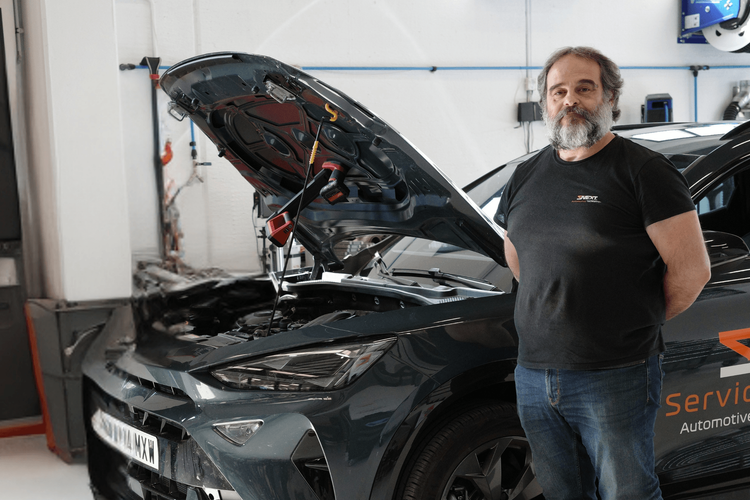
What a mechanic should know about the Cupra Formentor by Alfonso Ramírez, trainer at Next Academy
The Cupra Formentor presents itself as a model with its own identity within the VAG Group. The technical reality is that it shares more than 90% of its base with the Seat León, Volkswagen Golf, and Audi A3. This means that mastering this model allows you to work safely on all its VAG group equivalents.
The differences appear in specific elements that require the workshop to take a different approach to diagnosis and repair.
1.5 TSI EA211 EVO II Engine
This 1.5-liter engine does not operate with the conventional Otto cycle. It belongs to the latest evolution of the EA211 EVO II family and incorporates new components that set it apart from previous gasoline engines. For the mechanic, this poses a challenge: applying the same procedures as with other engines can lead to mistakes. Understanding its particularities is essential for correct and quick diagnosis and repair.
48V Electrical System
The Formentor adds a 48-volt mild-hybrid system. It is not just a reinforced alternator or a starter motor. This system is integrated into the management of the gasoline engine and influences its operation. This "intrusion" means that an electrical fault can easily be mistaken for a mechanical fault if the system as a whole is not understood. Thoroughly analyzing its components and their relationship with the engine prevents incorrect diagnoses.
SFD Security System
Another important innovation is the SFD security system. This mechanism limits access to the diagnosis of certain electronic units with the diagnostic machine. Knowing the correct procedure is essential to be able to work on these units without lockouts.
Electromechanical Brake Booster
The Formentor features an electromechanical brake booster. This component is increasingly present in new models from various manufacturers. For the workshop, it means a change in the way the brake system is approached and in usual maintenance routines.
Electrical Distribution and Schematics
As in every course, we review the vehicle's electrical and electronic distribution and its schematics. This step is essential to understand the overall behavior of the systems and to navigate diagnosis safely.
The Cupra Formentor does not represent a break within the VAG Group, but it does introduce elements that require additional knowledge in the workshop: 1.5 TSI engine with a different cycle, 48V electrical system, SFD security, and electromechanical brake booster. Understanding them thoroughly is what makes the difference between precise repairs or wasting time on incorrect diagnoses.
Personally, my impression is that this model generates more expectation than it actually delivers in terms of innovation. The Formentor eTSI aims to convey a sporty and personal character, but does so relying on an ECO label, 150 hp from its 1.5 TSI engine, a third-generation DSG gearbox, and the support of the 48-volt electrical system. The result is a balanced car, with a well-resolved chassis and a set of driver assistance systems that perform reliably.
Even so, it remains the most affordable model in the Formentor range, with a starting price around 33,000 euros. My opinion is that it appears to offer more than it actually does and, technically, it requires the mechanic to be prepared for systems that seem simple but hide significant challenges in the workshop.