
Automotive Sector and Auto Repair Shop News
NEXT MEDIA
partner by





News
Volver atrás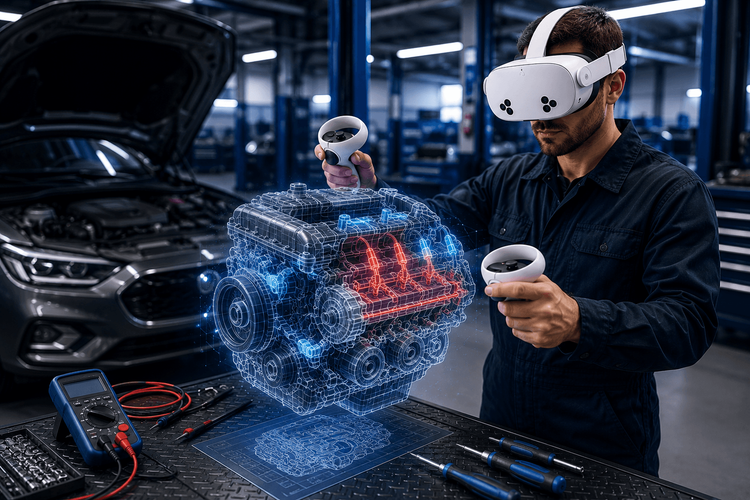
Automotive Diagnostics with Augmented Reality
Por Josué Arellano
The electronic diagnosis is part of the workshop's daily routine. Sensors, actuators, electrical diagrams, and testing procedures demand increasing precision, method, and technical knowledge.
In this context, augmented reality applied to automotive opens up a new way to learn and practice. It allows technical training to be transferred to an immersive environment where professionals can understand how a system works, locate components, follow diagnostic procedures, and repeat exercises without always relying on a real vehicle.
The objective is clear: to make learning more visual, practical, and safe, especially in areas where interpreting signals, electrical connections, and technical data is crucial.
From Electrical Diagram to Immersive Diagnostics
For years, diagnostic training has relied on electrical diagrams, technical documentation, and practice on real vehicles. These resources are still necessary, but the technological evolution of vehicles demands new tools to better understand what happens behind each component.
Augmented reality allows a technical procedure to become a visual and interactive experience. The student doesn't just consult a diagram: they can see the component in context, identify its connections, understand which signal needs to be checked, and follow an orderly diagnostic process.
This type of training helps to better internalize each step, especially in systems involving sensors, actuators, control units, and electrical signals that are not always easy to interpret at a glance.
A Virtual Workshop for Real Diagnostics Practice
Immersive training places the student inside a virtual workshop environment where they can practice with common automotive components, such as mass air flow sensors, pressure and temperature sensors, electronic throttles, injectors, coils, or EGR valves.
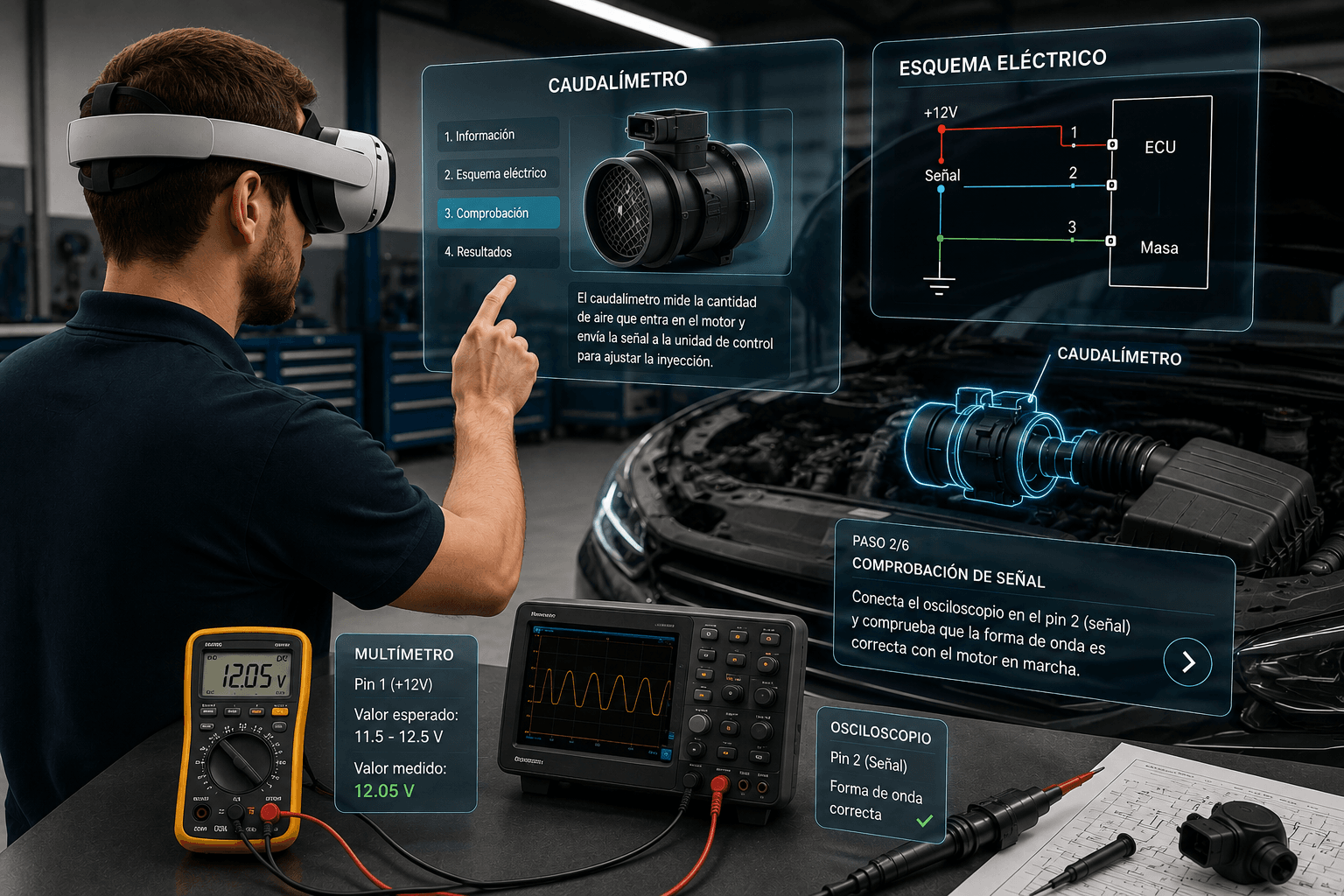
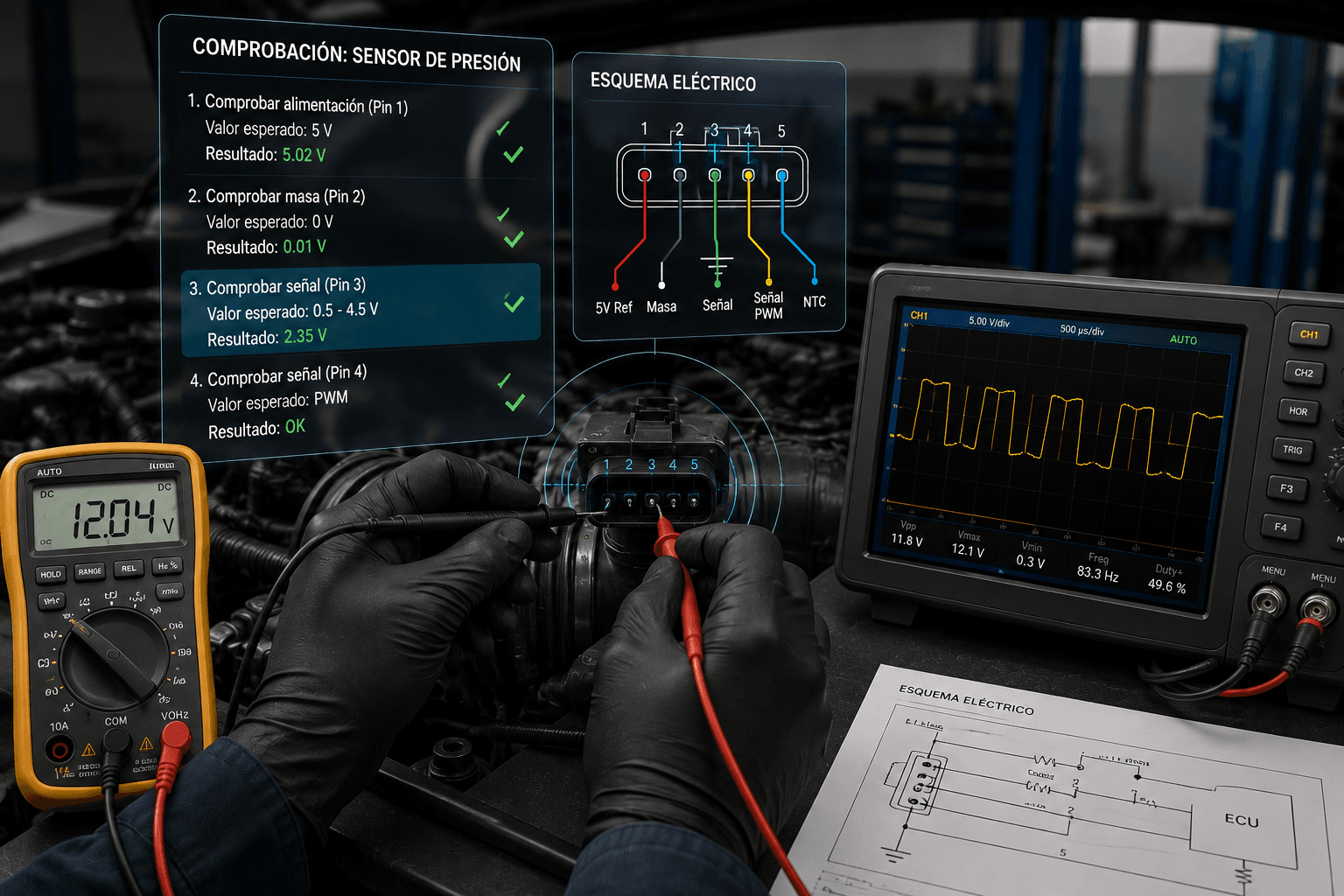
Each exercise follows a flow similar to a real workshop procedure. First, the technical information of the part is presented, such as the electrical diagram or an explanatory video. Then, the student performs the check using diagnostic tools like the multimeter or oscilloscope.
In this way, learning is not limited to memorizing data. The student learns to follow a diagnostic logic: check power supply, verify grounds, analyze signals, and understand the electrical behavior of each system.
Learning to Use Multimeter and Oscilloscope
One of the most important aspects of electronic diagnostic training is knowing how to correctly use the testing tools.
With the multimeter, the student can learn to measure voltages, grounds, or frequency signals. They can also identify the expected values at each pin and understand whether the reading obtained corresponds to correct operation or a possible fault.
With the oscilloscope, the training allows visualization of the waveform of a signal, interpretation of variations, and a better understanding of the behavior of certain electronic components.
Augmented reality facilitates this learning by visually showing where to connect, what to check, and how to interpret the result. This reduces the gap between theory and practice, especially for technicians who need to reinforce concepts of electrical diagnostics.
Repeatable, Safe, and Scalable Training
One of the main advantages of augmented reality in automotive is that it allows exercises to be repeated as many times as necessary, without depending on a specific vehicle or causing real faults.
This brings important benefits for training centers, workshops, and technical teams:
Training without risk to vehicles or components.
Lower costs in materials and equipment.
Ability to repeat diagnostics and simulate faults.
More organized and progressive learning.
Greater ease in standardizing technical procedures.
Additionally, this type of training allows students to prepare before working on a real vehicle. Thus, when the time comes to apply the procedure in the workshop, they already know the workflow, the basic checks, and the mistakes to avoid.
Monitoring Student Progress
Immersive training also allows usage and performance metrics to be recorded so that trainers and supervisors can objectively track learning progress.
Among the data that can be reviewed are:
- Time spent on each exercise.
- Number of sessions completed.
- Parts or exercises completed.
- Results obtained in assessments.
- Performance in each step of the diagnostic process.
This information helps identify which areas need reinforcement and allows training to be adapted to each student's real progress. Not all technicians learn at the same pace or have the same needs, so having data enables more personalized and effective training.
Augmented Reality for More Accurate Diagnostics
Augmented reality does not replace real work in the workshop, but it does better prepare professionals before facing a fault.
In an environment where electronics are increasingly important, this type of training helps accelerate learning, improve diagnostic understanding, and reduce errors in technical procedures. The student can practice in a controlled space, repeat checks, and gain confidence before applying their knowledge to a vehicle.
The combination of visual training, simulation, and learning tracking allows for the creation of more efficient, accessible, and tailored environments to meet the current needs of the sector.
The Future of Technical Training is Also Practiced
As vehicles incorporate more electronics, sensors, control units, and complex systems, technical training needs to evolve.
Augmented reality applied to automotive diagnostics turns learning into a more practical, visual experience, closer to the daily reality of the workshop. It allows for a better understanding of systems, training in procedures, and preparing professionals to work with greater safety and precision.
At Service Next, we work to bring technology closer to the workshop in a useful and practical way. Immersive training with virtual and augmented reality enables technical teams to prepare for increasingly complex diagnostics, with tools adapted to the sector's reality.
Today's diagnostics no longer depend solely on knowing how to read a diagram. It also requires interpreting data, understanding signals, and practicing in environments that help turn technical knowledge into real experience.
Contact us!
Partner by